
Key Lessons from Trinidad and Tobago on Implementing Safe, Inclusive and Interoperable DPI – No Matter Your Size
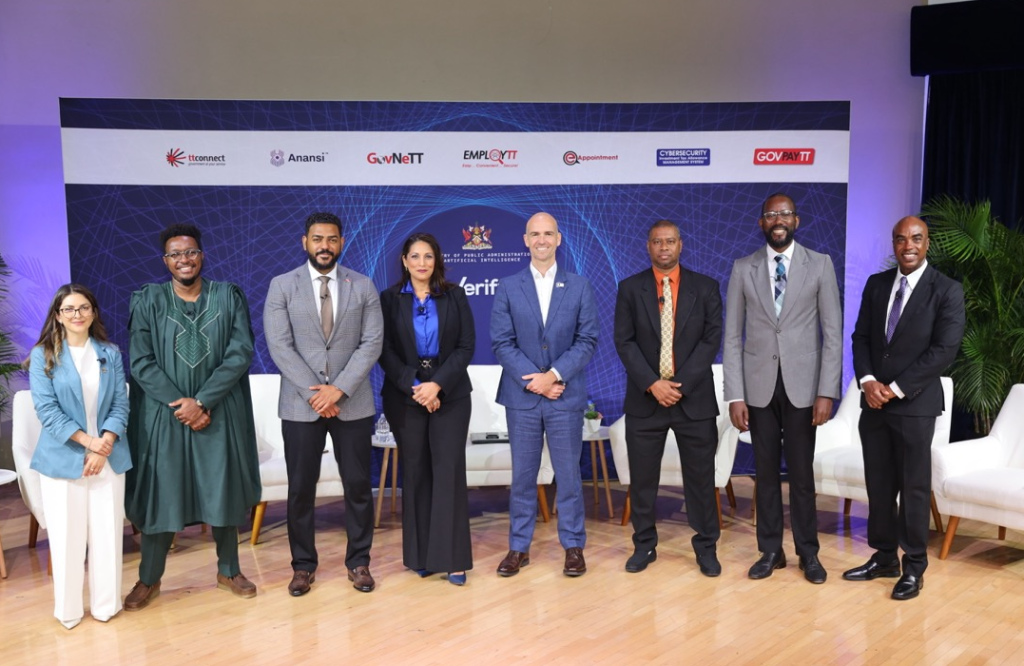
Pictured from left to right: Veronica Vasconez (IDB), Antony Muriithi (CDPI), Senator the Hon. Dominic Smith (Ministry of Public Administration and Artificial Intelligence), Ria Karim (iGovTT), Jon Lloyd (DPGA Secretariat and 50-in-5), Professor David Alexander (UTT), Irwin Williams (iGovTT), and Charles Bobb-Semple (iGovTT).
Until just a few years ago, it was thought that digital transformation was the domain of large, well-resourced countries. But Trinidad and Tobago is one of many that have flipped the script, and shown what’s possible no matter its size.
“The Caribbean Catalyst: VerifyTT and the Next Generation of Public Services”, a hybrid event held on July 22nd, 2026, brought together members of the 50-in-5 community and special guests at the invitation of Trinidad and Tobago. Held in Port of Spain, the event featured senior leaders from the country, the Inter-American Development Bank, the Centre for Digital Public Infrastructure (CDPI), and academia to highlight the concrete example of VerifyTT, showing how Small Island Developing States (SIDS) can build safe, inclusive, and interoperable DPI using open-source foundations.
Here are the key insights and takeaways from the event:
1. Even Small Countries Can Do Digital Transformation
Trinidad and Tobago leverages its size as a key agility advantage, according to Senator the Honourable Dominic Smith, Minister of Public Administration and Artificial Intelligence. He stated that this allows for rapid innovation, supported by one of the first open-source programme offices (OSPOs) in the world. This approach to digital implementation is setting a new global standard for digital transformation.
2. Using Open Source and Digital Public Goods Helps Secure Digital Sovereignty
Using DPGs and open-source software helps prevent vendor lock-in, giving governments full control and agency over their data and systems. This approach provides a strong cost advantage as well. Rather than reinventing the wheel, reusing DPGs allows countries to build on trusted, reusable components tailored to their local contexts, just as Trinidad and Tobago has done with VerifyTT.
However, this must also go hand in hand with building institutional capacity. Trinidad and Tobago is taking this approach with the long-term objective of:
- Capable public sector teams
- Strong governance frameworks
- Sustainable partnerships with public institutions and the private sector
- Digital skills and confidence among government employees
The government recognises the human element of DPI and invests heavily to help maintain trust in government institutions.
3. Start Small and Build on High Value Use Cases
Countries don’t need to implement all DPI elements at once. VerifyTT is just the start of a much larger national digital strategy. Following the successful launch of the verify tool, the government is working on three additional DPI components:
- National Digital Identity, enabling secure authentication for citizens accessing government services.
- Interoperability Platform, allowing government agencies to securely exchange verified information.
- Benefits Wallets (KTT), designed to modernise the delivery of social assistance through shared digital infrastructure.
Antony Muriithi, Principal Technical Architect at CDPI, advised governments to always start with a high-value use case to demonstrate early impact before scaling technology.
4. Keep People at the Centre and Design For Radical Inclusion
One of the key takeaways was that digital transformation is measured by meaningful improvements in people’s lives, not by the number of platforms implemented.
As a result, Trinidad and Tobago are taking a “tell us once” approach to their digital strategy, meaning people will only need to provide information once, and authorised agencies will be able to reuse that verified information.
Crucially, this will be consent-based, and the country places emphasis on governance as a key tool for maintaining trust.
The “tell us once” approach is expected to:
- Reduce bureaucracy
- Improve efficiency across government sectors to deliver services more effectively
- Enhance public service delivery from a citizen point-of-view
- Strengthen data security and accountability
Ria Karim, Chairman of iGovTT, highlighted that DPI must be designed for radical inclusion from day one – ensuring vulnerable, offline, or low-tech communities are never left behind.
Professor Davis Alexander highlighted the University of Trinidad and Tobago’s pilot program with university graduates, proving that digital credential verification must keep meaningful user consent at the core of data protection.
Trinidad and Tobago’s open approach to digital development, alongside its achievements, embodies the 50-in-5 spirit. Veronica Vasconez from the Inter-American Development Bank pointed out that Trinidad and Tobago’s blueprint for proving what’s possible is already sparking regional knowledge-sharing partnerships with countries like Jamaica, Barbados, and St. Kitts and Nevis.
The successful implementation and ongoing rollout of VerifyTT proves that scale is no barrier to world-class innovation. By eliminating administrative friction, putting citizens at the heart of digital strategy, and prioritising inclusive design, even small countries can drive big transformation.