
From Promise to Progress: Celebrating the Inaugural 50-in-5 Awards – Leadership
Welcome to From Promise to Progress: Celebrating the Inaugural 50-in-5 Awards, a three-part blog series highlighting the countries and individuals driving transformative digital public infrastructure around the world.
What can countries achieve when they use digital public infrastructure to build stronger economies and more resilient communities? In 2023, the 50-in-5 campaign was launched to help bring countries together to implement safe, inclusive and interoperable digital public infrastructure (DPI). The goal of the campaign is to enable 50 countries to design, implement, and scale at least one component of their DPI by 2028.
Today, 41 countries are part of the growing 50-in-5 community, drawing from one another’s experiences, sharing knowledge and technology, building on what works and learning together from what doesn’t. Over the past three years, participating countries have come together through workshops, roundtables, ministerial meetings, and peer learning exchanges to share lessons and best practices in DPI. In 2026 alone, countries participated in 24 virtual and in-person events, including learning programs on evolving DPI safeguards and the integration of AI into DPI implementation. These exchanges are helping bring the vision of 50-in-5 to life, creating a space for governments and partners to accelerate implementation, reduce costs, and sustain the momentum of their digital transformation efforts.
At the halfway point of the campaign, the inaugural 50-in-5 Awards recognise the countries and people delivering real-world progress through DPI. Across the categories of Impact, Collaboration, and Leadership, the Awards highlight the individuals, partnerships, and innovations behind DPI implementations that are helping build stronger economies and improve the well-being of people.
“Keep people and real-world impact at the center of your DPI implementations, remembering that it is an enabler, not the goal in itself. Share what you’re learning so others can benefit, and invest in the people and solutions—including digital public goods—needed to sustain this work. Through 50-in-5, we can work together to accelerate safe, inclusive, and interoperable DPI around the world,” shared Jon Lloyd, Director of Advocacy and 50-in-5, DPGA Secretariat.
This year’s honorees exemplify what effective DPI looks like in practice and why cooperation matters, particularly at a time of geopolitical uncertainty and rapid technological change. Let us meet the people and countries behind these achievements.
Leadership | Navigating Complexity to Build Public Trust
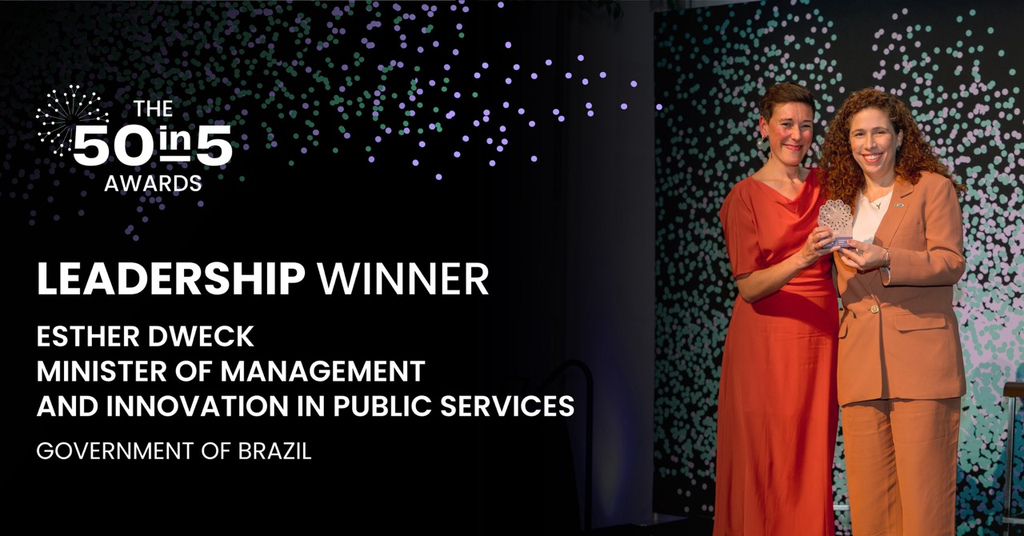
Leadership Award: Esther Dweck, Brazil
People are at the heart of DPI implementation, particularly champions who can bring partners together and move plans forward. The Leadership Award recognises individuals who build partnerships, share knowledge, and navigate implementation challenges in their respective DPI efforts.
This year’s awardee, Esther Dweck, Brazil’s Minister of Management and Innovation in Public Services, demonstrates this leadership through her work in Brazil and internationally. Minister Dweck has helped advance digital systems that make government services easier and safer to access. Under her leadership, Brazil has strengthened GOV.BR, PIX, and ConectaGov, which allow people to verify their identity, receive payments, and access public services online. These systems proved valuable during the severe floods in Brazil. The Ministry of Management and Innovation in Public Services used GOV.BR and PIX to help deliver emergency benefits within six days, showing how existing digital systems and coordination across government can support a faster crisis response.
Beyond Brazil, Minister Dweck has also championed international cooperation, helping advance discussions on digital identity governance through the G20 and supporting the establishment of a joint DPI Center with India. Her leadership shows how champions can align institutions and partners around practical solutions that expand access to services and strengthen government capacity.
“By bringing together our national identity card, GOV.BR, and CONECTA.GOV.BR, we are creating a sovereign digital public infrastructure that allows public services to become increasingly proactive, while ensuring that inclusion, accessibility, privacy, and trust remain at the center of everything we do,” said Esther Dweck, Minister of Management and Innovation in Public Services, Government of Brazil.
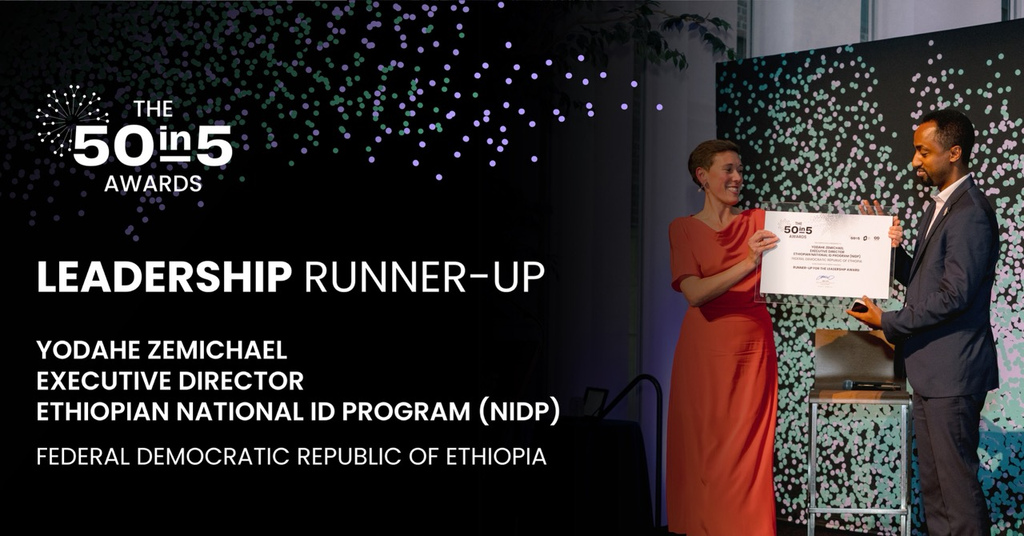
Leadership Runner-Up: Yodahe Zemichael, Ethiopia
Yodahe Zemichael, Executive Director of Ethiopia’s National ID Program (NIDP), was honoured as runner-up for his leadership in advancing Fayda, Ethiopia’s foundational digital identity system, and expanding access to essential services throughout the country as a result.
What’s Next
Across the globe, we are seeing champions of digital public goods turn the promise of DPI into real outcomes. From expanding access to services in Benin, to strengthening regional cooperation in Indonesia, to advancing people-centered leadership in Brazil, these stories show that the vision behind 50-in-5 is no longer an aspiration. It is already becoming a reality, improving lives and creating opportunities for millions of people.
As the inaugural 50-in-5 Awards showed, sustaining this momentum will take continued commitment. Countries must keep people’s experiences at the centre of DPI, share practical lessons, explore reusing technology, and invest in the people and digital public goods behind lasting progress. Measuring real-world outcomes will help countries build on what works and address the challenges that remain.
As the campaign reaches its halfway point, this year’s honorees offer examples of what is possible, along with helpful takeaways for countries at every stage of their DPI journeys. We look forward to seeing what they achieve next—and to celebrating more of that progress at the 2027 50-in-5 Awards.